Manhwa is gaining ground with international readers, but the available evidence does not support a clean claim that it is replacing manga worldwide. The more defensible conclusion is narrower: Korean digital comics and vertical-scroll webcomics have become powerful channels for mobile reading, fandom, and cross-media intellectual property, while manga remains a large and increasingly digital business. This guide separates market forecasts, company results, and reader surveys so that each number answers the question it was actually designed to measure.
Start With Definitions: Manhwa, Manga, and Webtoons Are Not Interchangeable
Manga generally refers to Japanese comics, manhwa to Korean comics, and webtoon to a digital-comic format and distribution ecosystem associated with vertical scrolling. A webtoon is not automatically Korean, and a manhwa title is not automatically published in vertical-scroll form. Our guide to Korean manhwa and Japanese manga explains the creative and publishing differences in more detail.
This distinction matters because many market reports measure “webtoons,” not the entire manhwa industry. Their estimates can include titles, platforms, and revenue that would be excluded from a Korea-only definition. Conversely, manga sales include print and digital editions across many channels. Treating a webtoon forecast and a manga forecast as two scores in the same contest creates a false comparison before the analysis begins.
What the Market Reports Actually Say
Grand View Research’s webtoons market report, last updated in November 2026, values that market at $14.4 billion in 2025. It lists $18.3 billion as a 2026 estimate and $101.4 billion as a 2033 forecast, with a projected 27.3% CAGR for 2026–2033. The 2026 figure is an estimate, not audited revenue already collected, and the 2033 figure is a forecast rather than a guaranteed outcome.
The same research firm’s manga market release forecasts $43.8561 billion by 2033 and a 20.5% CAGR for 2026–2033. It also says digital content accounted for more than 66% of manga revenue in 2025. That single detail undermines the simplistic idea that manga means print while manhwa alone owns digital reading.
A separate comic book market report identifies manga as its largest genre segment, with a 45.5% revenue share in 2025. That is a third market definition, not a denominator that can be combined with the webtoon and manga reports above.
| Dataset | Verified figures | Correct interpretation |
|---|---|---|
| Global webtoons | 2025: $14.4B; 2026 estimate: $18.3B; 2033 forecast: $101.4B | A webtoon-category model, not a Korea-only manhwa total |
| Global manga | 2033 forecast: $43.8561B; digital share above 66% in 2025 | A manga-specific forecast covering print and digital |
| Global comic books | Manga genre share: 45.5% in 2025 | A broader comic-book segmentation with its own scope |
These reports are useful for directional analysis, but their scopes overlap and their methodologies are proprietary. They cannot prove that one medium has taken a precise amount of market share from the other. Unsourced market values, platform rankings, and adaptation counts should not be used to fill those gaps.
Company Results Show Momentum—and Volatility
Market forecasts are not company earnings. WEBTOON Entertainment’s third-quarter 2026 results reported revenue of $362.8 million, down 4.0% year over year on a reported basis. On a constant-currency basis, revenue was $378.6 million, up 0.2%. The quarter also included a $7.5 million net loss and $2.2 million in adjusted EBITDA.
The revenue mix was equally nuanced. Paid Content revenue was $275.5 million, down 3.9% as reported; Advertising revenue was $49.7 million, up 26.2%; and IP Adaptations revenue was $37.6 million, down 27.5%. Those figures show both growth and contraction inside the same company. One quarter does not establish a long-term trend, but it does rule out an honest narrative in which every part of the webtoon business is effortlessly accelerating.
Audience totals require the same care. In that November release, WEBTOON Entertainment described approximately 159 million monthly active users across its IP & Creator Ecosystem. The listed ecosystem includes WEBTOON, Wattpad, LINE MANGA, eBookJapan, and other aligned brands and platforms. It is therefore incorrect to relabel the figure as users of the English-language WEBTOON comics app, unique people worldwide, paying readers, or manhwa readers alone.
What Reader Research Says About Mobile-First Appeal
Reader surveys answer a different question: why people who already use the format enjoy it. In September 2026, WEBTOON Entertainment and National Research Group published Inside Webcomic Fandom. NRG conducted a US online survey in April and May 2026 among more than 500 respondents aged 13–49 who read webcomics at least monthly.
Within that selected sample, 80% said they loved or liked webcomics, 90% often chose webcomics over other entertainment activities, and more than 80% were excited about animated adaptations. These are useful indicators of engagement among regular webcomic readers. They are not measurements of the entire global population, all manga readers, or a representative sample of non-readers. The research was also published by a platform company, so its methodology and framing should remain visible whenever its percentages are quoted.
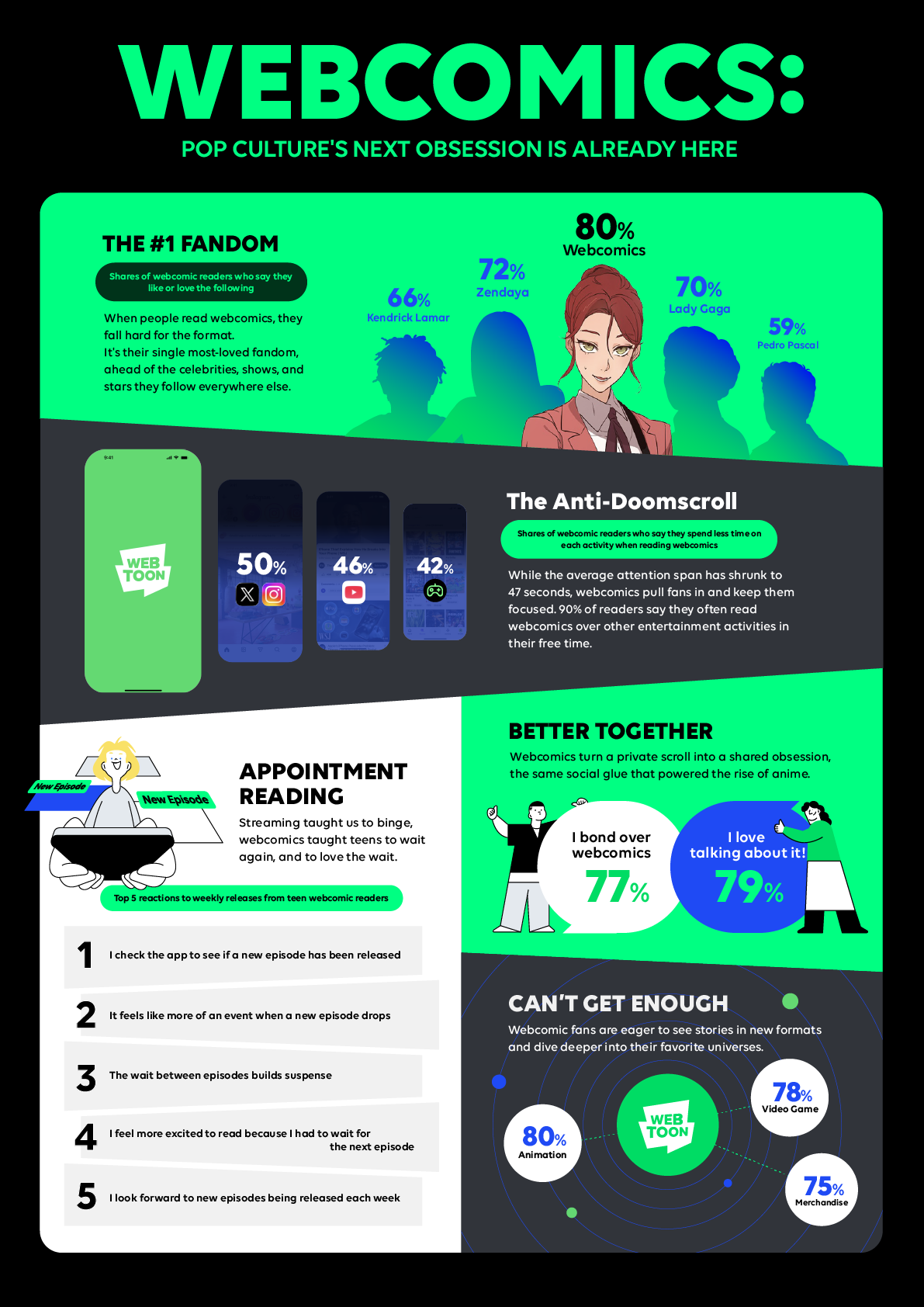
The format’s practical advantages are easier to understand without turning them into superiority claims. Vertical scrolling reduces page-turning and zooming on a phone; episode notifications support habitual reading; comments and recommendations make discovery social; and free entry points lower the cost of trying a new series. Readers who want a practical starting point can use our complete beginner’s guide to reading manhwa.
Digital Distribution Changes Discovery, Not the Whole Market
Digital platforms can serialize an episode, recommend related titles, localize a release, and convert successful stories into adaptations without waiting for a print volume in every territory. Those capabilities help explain why webcomics are visible in streaming and social-media conversations. However, manga publishers also operate digital services, simultaneous-release programs, and global licensing businesses. Digital distribution is an area of competition and overlap, not a feature possessed by only one side.
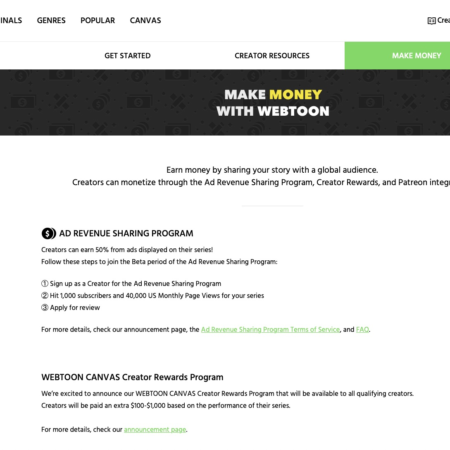
The business model is just as varied. Free episodes, virtual currency, subscriptions, advertising, collected editions, and adaptation licensing can coexist. Our guide to how manhwa artists get paid shows why platform growth does not translate automatically into a fixed creator income, while the manhwa industry pipeline explains the roles between creation and publication.
Platform Headlines Are Not a One-Way Growth Story
Tapas provides a necessary counterexample to the idea that every platform is expanding without interruption. Its official End of Service FAQ says users could no longer acquire new Ink from October 1, 2026, and that the service will end at 11:59 p.m. Pacific Time on March 31, 2027. The FAQ also warns that unlocked content will no longer be accessible after closure. A shutdown does not prove that webcomics are declining overall; it does prove that platform-level outcomes differ.
This is also why registered-account totals should never be presented as active readership. A Tappytoon figure described as “registered readers,” for example, measures accounts under that platform’s definition and reporting date. It is not interchangeable with WEBTOON Entertainment’s ecosystem MAU or a monthly paying-user count. Without aligned definitions, periods, and brand coverage, there is no sound platform league table to calculate.
For readers, availability is more useful than a simplistic ranking. Catalogs, pricing, regional licenses, and service continuity vary, so our guide to legal manhwa platforms is a better starting point than treating the largest headline number as the best service.
So Why Does Manhwa Feel Like It Is Replacing Manga?
For a mobile-first reader, the perception is understandable. A recommendation can lead directly to a free episode, the vertical layout fits the device already in hand, and an adaptation can send attention back to the source comic. Korean action-fantasy and romance titles are especially visible in these recommendation loops. At the same time, manga continues to benefit from large catalogs, print collecting, digital sales, anime, retail distribution, and long-running communities.
The apparent “replacement” is therefore often a change in discovery and reading context, not evidence that manga readership has disappeared. Someone may read a vertical-scroll episode during a commute and a digital or print manga volume at home. Those behaviors can coexist within the same person, which makes exclusive either/or claims particularly unreliable.
Conclusion
Manhwa and webcomics are reshaping how many readers discover, serialize, and discuss comics. Verified forecasts point to substantial webtoon-market growth, and platform research shows strong engagement among existing webcomic readers. But manga remains digitally significant, holds a leading genre position in Grand View Research’s comic-book segmentation, and is also forecast to grow. The best-supported answer is competition and coexistence across formats, not a proven global replacement. Any future update should preserve the date, metric definition, geographic scope, and source beside every number.
Sources and Verification
- Grand View Research — Webtoons Market Report (market estimates and forecasts; page last updated November 2026).
- Grand View Research — Manga Market Growth & Trends (January 2026; forecast and 2025 digital-share highlights).
- Grand View Research — Comic Book Market Report (2025 genre segmentation).
- WEBTOON Entertainment — Third Quarter 2026 Financial Results (November 9, 2026; company-reported financial and ecosystem metrics).
- WEBTOON Entertainment and NRG — Inside Webcomic Fandom (September 21, 2026; US survey methodology and findings).
- Tapas — End of Service FAQ (updated October 1, 2026; Ink and shutdown dates).
All source pages and publication details were checked on November 22, 2026. Market-research figures are estimates or forecasts unless explicitly described as company-reported actuals.